Digital Workforce Platform: Add a Scrum team, or one more teammate, in minutes, not months.
AI Digital Employees that join your backlog as a new Agentic Scrum Team or as members of your existing one, working within your tools, policies and compliance, at the autonomy level you choose, with a person always approving the gates that matter.
Neotyk is more than a coding assistant. Its Digital Employees take assignments, follow your process, report progress and escalate like members of your team.
of the cost of contractor capacity ($25–$250/hr).
to provision a Digital Employee, vs 3–11 weeks to hire.
execution, with a human approving every gate that matters.
A Digital Employee: more than a coding assistant
Neotyk delivers Digital Employees that work within your corporate standards, compliance and governance. Coding assistants make developers faster.
| Neotyk Digital Employee | Coding assistant | |
|---|---|---|
| Works for | Your team, in your existing tool ecosystem | One developer, in their IDE |
| How work arrives | An assigned ticket, sprint or backlog | A prompt |
| Roles | Product Analyst, Developer, QA, DevOps, and more roles over time | Writes code |
| Behavior | Works autonomously within the limits you set; asks for approval, escalates, hands off, reports progress | Answers what it's asked |
| Standards | Your policies override built-in runbooks; your SDLC and approval gates | Whatever the user types |
| Accountability | Audit log of every action; a person approves each gate | None beyond the chat |
| Replaces | Contractor and staff-augmentation capacity | Nothing; it's a productivity add-on |
A governed Digital Workforce, working today
Real screens from the Neotyk console at console.neotyk.ai, where four Digital Employees (Product Analyst, Developer, QA and DevOps) work as one Agentic Scrum Team. Personal details are blurred.
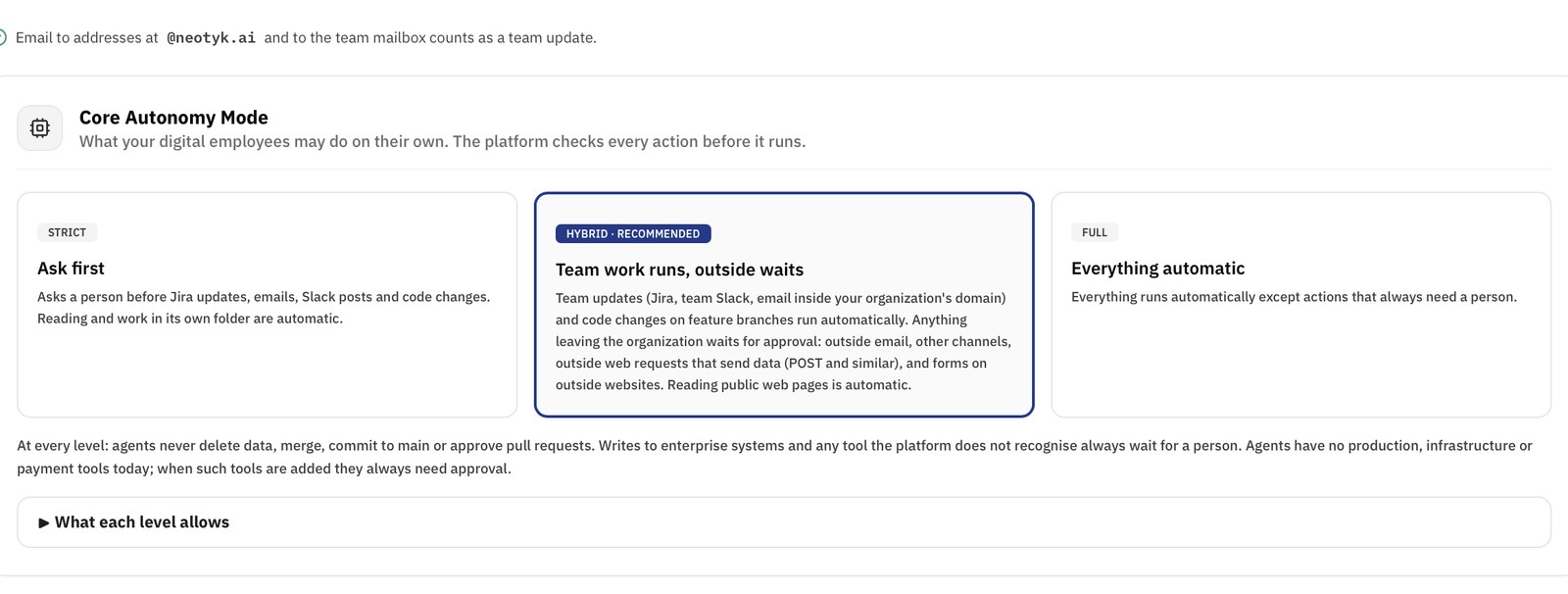
You decide what they may do on their own
Pick an autonomy level for your organization, and the platform checks every action before it runs. In Hybrid, team updates and code changes on feature branches run automatically; anything leaving your organization waits for a person.
- ✓Strict, Hybrid or Full autonomy
- ✓Agents never delete data, merge, commit to main or approve pull requests
- ✓Writes to enterprise systems and unknown tools always wait for approval
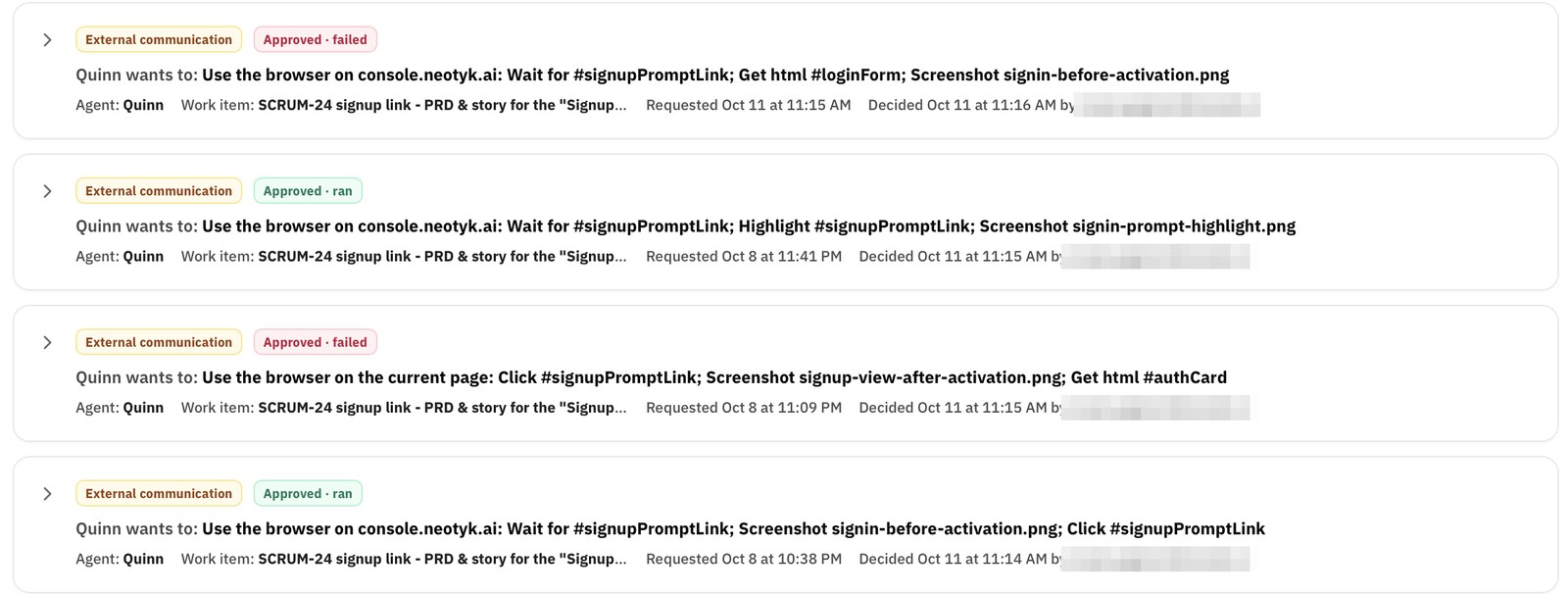
People approve at every gate
When an action needs a person, the Digital Employee asks. You see the exact action, approve it to run as shown, or reject it and tell the agent why.
- ✓Team gates for scope, code review and release
- ✓Outside communication approved before it runs
- ✓Every decision recorded; open requests expire after 72 hours
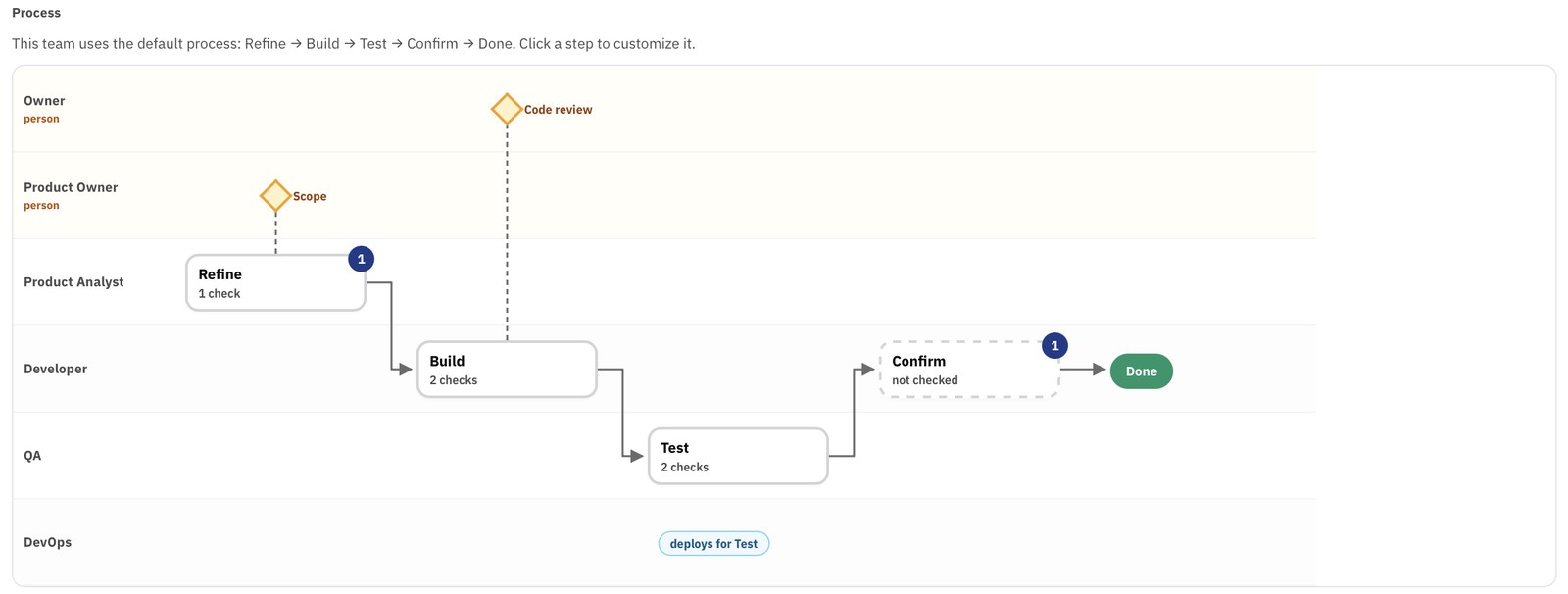
Digital Employees hand work to each other
A team works through your process, by default refine, build, test and confirm. Each step sits in the lane of the role that does it, the platform checks each hand-off, and approvals sit in the lane of the person who gives them.
- ✓Your Product Owner approves scope; a second reviewer approves every pull request
- ✓Solid steps are enforced by the platform; dashed steps are guidance
- ✓Production deploys wait for the Owner's go-live approval
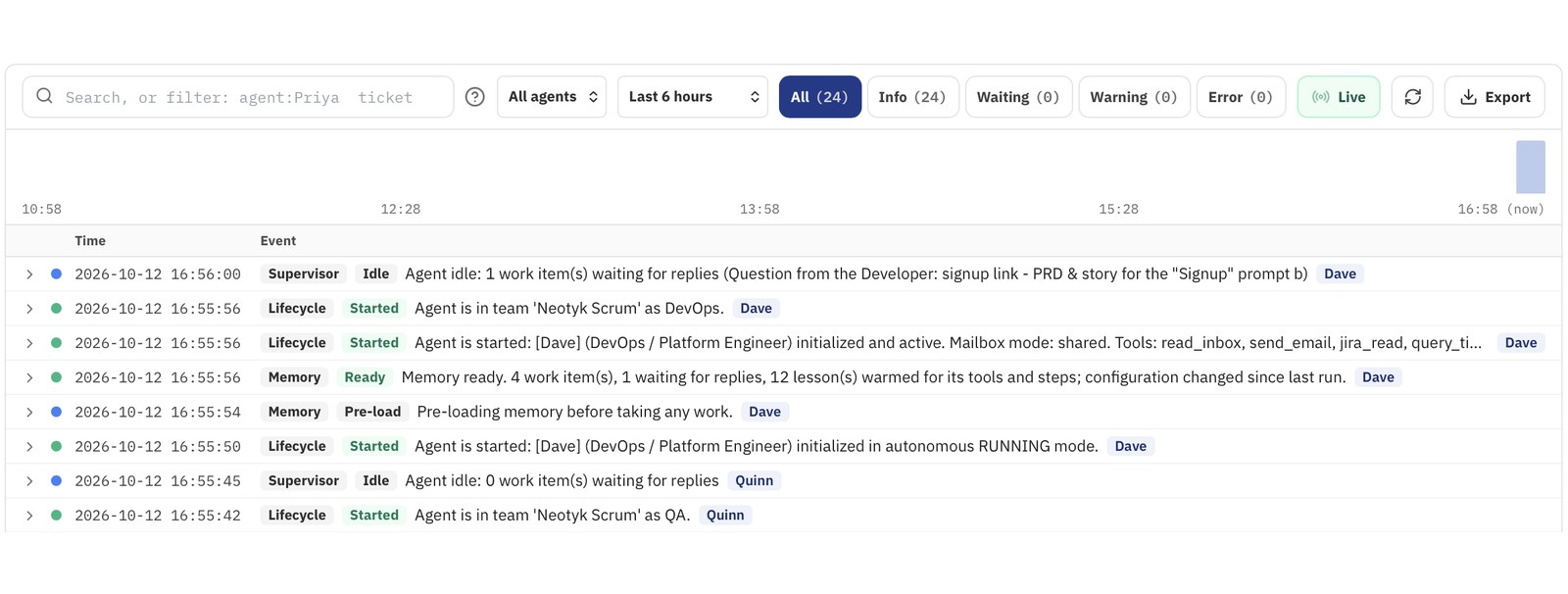
Every action, recorded
Everything your Digital Employees do lands in the audit log, one line per event: tool calls, results and reasoning steps. Filter by agent or ticket, follow it live, and export it for your compliance team.
- ✓One line per event, filterable by agent, ticket and severity
- ✓Live view and export
- ✓Model usage and cost tracked per agent and per task
This is the live console, not a mock-up.
Engineering capacity is slow, costly and hard to flex
Whether they hire or contract, companies add engineering capacity one person at a time.
Per engineer, fully loaded: US median pay $135,980 plus benefits. 6–11 weeks to hire, longer for senior roles, and hard to scale back down.
From offshore teams to US agencies, 3–6 weeks to staff. Pay keeps running for as long as the work does.
Per person. Doubling output means doubling headcount or hours. Vendor teams also turn over 13–15% a year, taking system knowledge with them.
Sources: BLS Occupational Outlook, software developers (May 2025) and Employer Costs for Employee Compensation (Jun 2026), ~$199K = median pay ÷ 68.5% wage share; KORE1 (2026); Fullstack Labs 2026 Price Guide; company-reported attrition, Q1 FY26.
Role × Skill × Guardrail
Three independent controls decide how every Digital Employee behaves, what it knows, and what it can never do.
Role: how it behaves
Each Digital Employee has one role, which sets its responsibilities, decision rights and hand-offs. You choose its autonomy level: Strict, Hybrid or Full.
Skills: what it knows
53 enterprise runbooks plus your own SDLC, PR template, coding standards and definition of done.
Guardrails: what it can never do
Enforced beneath the agent: destructive-action blocks, secret scanning, network allow-lists, short-lived credentials and human approval gates.
From one Digital Employee to your whole workforce
Start with a single agent, add a full Agentic Scrum Team, or run a governed fleet in your own cloud.
Individual Digital Employees
Put one to three Digital Employees to work on your tickets. Each one follows your process, works within the responsibilities of its role, and hands back pull requests you approve.
Each role comes with its complete skill set, and your company policies override the built-in runbooks.
Branching rules, PR template, coding standards and definition of done, enforced on every task.
Tickets become tested pull requests, with a full audit trail. You approve every merge.
GitHub, CLI and IDE integration, running in a dedicated sandbox per agent.
Start with a trial
Starter: 7-day self-serve trial. Teams: 14-day invite-only trial, one full sprint with an Agentic Scrum Team.
Your team’s process, with people at every gate.
In an Agentic Scrum Team, Digital Employees (Product Analyst, Developer, QA, DevOps, and optionally a Tech Lead) hand work to each other through refine → build → test → confirm, and the platform checks each hand-off. Your Product Owner approves scope, a second reviewer approves every pull request (the Tech Lead agent, or the Owner if there is none), and your Owner approves go-live.
Contractor capacity vs. Neotyk Digital Employees
Priced against your contractor budget, not your dev-tools budget.
| Dimension | Contractors & staff augmentation | Neotyk Digital Employees |
|---|---|---|
| Cost | $25–$250 per hour, per person | < 1/10th of contractor cost (a full 8-agent Teams plan is $3,800/month) |
| Time to add capacity | 3–11 weeks to hire an engineer | Minutes to provision a Digital Employee |
| Working hours | ~40 hours / week per person | 24/7, with human approval gates |
| Knowledge retention | 13–15% annual attrition at large IT services firms | Persistent team knowledge: repos, tickets and decisions |
| Process compliance | Varies by vendor and individual | Your SDLC and definition of done enforced, with an audit trail |
| Procurement | MSA & SOW cycles | Self-serve plans, or an annual Enterprise license |
Contractor figures: Fullstack Labs 2026 Price Guide; KORE1 2026; company-reported attrition Q1 FY26.
Included on every tier, never a paid upgrade
Every Neotyk agent runs in its own dedicated sandbox with secure, scoped tooling, follows your SDLC and definition of done, works within its role and the autonomy level you set, and operates under enforced guardrails with a complete audit trail.
Each task runs in an isolated sandbox that is torn down when the work is done.
Tools and credentials are limited per agent and expire quickly. Platform secrets stay separate from your tool settings.
Merges, migrations and deploys wait for a human. Every action is recorded against the ticket.
Customer code, tickets and outputs are never used to train AI models.
Put Digital Employees on your backlog
Start with one Digital Employee in minutes, or apply to run a full Agentic Scrum Team for a sprint.